What a UL508A Control Panel Is, and Why a Packhouse Should Ask for One
The label on a control panel says more about your plant's safety and uptime than most managers realize.
October 7, 2026 · 4 min read
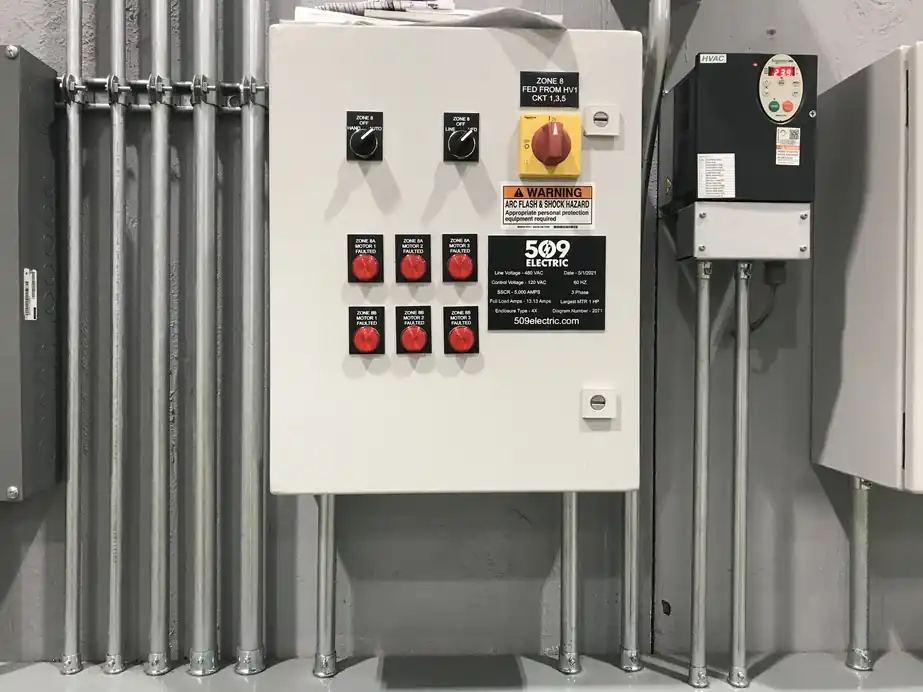
Walk the wall of a packhouse or a cold room and you'll find rows of gray enclosures with a disconnect handle on the side, a few pilot lights on the door and a nameplate. Most people only look at that nameplate when something stops running. UL508A is the standard behind it, and it's worth understanding before you buy your next panel.
What UL508A actually covers
UL508A is a safety standard for industrial control panels. A control panel is the box that takes incoming power and decides what runs. Inside you'll find motor starters, variable frequency drives, relays, PLC hardware, fuses, breakers, terminal blocks and all the wiring that ties them together. The standard sets rules for how that assembly is built: how parts are chosen and protected, how wire is sized and routed, how the enclosure is matched to the environment, and how the finished panel gets marked.
One of the most useful things on a properly built panel is the short-circuit current rating on its label. That number tells you how much fault current the panel can handle as built. Without it, an inspector, an engineer or your own maintenance supervisor has very little to go on, and a guess is a poor foundation for a panel fed from a large service. A shop that builds to the standard puts that rating on the label and keeps the paperwork behind it.
Why it matters on a packhouse floor
Packing lines and cold storage are hard on electrical gear. You've got washdown, condensation, dust, forklift traffic and rooms that swing between temperatures. A single line can have dozens of motors on it. Some run on drives, some run straight across the line, and all of them take their instructions from a PLC that decides when each one starts and stops.
When a panel is built carelessly, you feel it as nuisance trips, a drive that overheats because the enclosure can't shed its heat, or a terminal that works loose from vibration and takes a conveyor down at the worst moment of the season. None of that shows up in a catalog price. It shows up in downtime.
A quick word on drives, since the term comes up constantly. A variable frequency drive, or VFD, controls motor speed by changing the frequency of the power going to the motor. It's how a conveyor can ramp up gently instead of lurching to full speed with a load of fruit on it. Drives also make heat, so a good panel layout gives that heat somewhere to go and keeps the drive away from things that don't like it.
What our Yakima panel shop builds
Our shop builds custom industrial control panels to the UL508A standard. They're designed, assembled and documented in-house in Yakima, whether the job is a single replacement panel or a run of panels for a larger build-out. Nick Nalley, who co-owns 509 Electric and handles estimating and project management, came up as an industrial electrician before starting the company in 2018. The panel shop reflects that background.
The photo with this article shows a custom control panel with a 509 Electric nameplate, red pilot lights, a disconnect and a drive, from our 2021 Cold Room project. We also do PLC programming, which means the people who build the panel can also write the logic that runs inside it. That removes a lot of finger pointing at startup, because there's one team answering for the hardware and the program together.
Questions worth asking any panel builder
Whoever builds your next panel, these questions will tell you quickly how they work:
- Is the panel built and labeled to UL508A, and can I see the short-circuit current rating on the label?
- Who designs it, and will the drawings I receive match what is actually inside the enclosure?
- Who programs the PLC, and do I get a copy of the program along with the as-built drawings?
- How are the wires and terminals marked, so my maintenance crew can find a circuit in the middle of the night?
- What happens when I need to change the panel next season?
The drawings question matters more than people expect. A panel with accurate documentation can be serviced by anyone on your maintenance team. A panel without it turns every repair into an investigation, and the person who understood it usually retired three years ago.
Replacement panels and new builds
Plenty of panel calls start with something old. A panel has been modified so many times that nobody trusts the drawings, or a key part is no longer made. Replacing the whole panel in one planned shutdown is often cheaper than patching it for another season once you count the lost production. A replacement is also the right time to ask for spare capacity. A few extra I/O points and some empty room in the enclosure cost very little today, and they make it much easier to add a line or a sorter later.
We build both kinds: one-off replacement panels and runs of panels for new lines. If you're planning a packing line, a cold room or a plant upgrade anywhere in Yakima or Central Washington, call (509) 571-1082 and send us the drawings or walk us through the floor. You'll get a straight answer on scope, schedule and price.
509 Electric, (509) 571-1082
Call (509) 571-1082More articles
Planning Electrical Service for a Cold Storage Room or Packhouse Expansion
Most expansion headaches trace back to a service that was sized for the plant you had, not the one you're building.
How Street Lighting and Traffic Signal Work Fits Into a Public Road Project
Lighting and signals look like the last thing installed on a road job, but the electrical work starts well before the paving.