How Street Lighting and Traffic Signal Work Fits Into a Public Road Project
Lighting and signals look like the last thing installed on a road job, but the electrical work starts well before the paving.
October 7, 2026 · 3 min read
Drive through a new intersection and the street lights and signals look like finishing touches. For the crews building it, they're anything but. Most of the electrical work on a road project happens underground, early, and in tight coordination with the civil contractor. If that coordination goes well, the lights come on without drama. If it doesn't, you end up cutting fresh pavement.
What the electrical scope usually includes
On a typical road improvement, the electrical scope can include a service cabinet where power is metered and fed, underground conduit running to every pole and signal location, pull boxes along the way, pole foundations, the poles and luminaires themselves, signal equipment and the wiring that connects it all. Our infrastructure crews install and maintain street lighting and traffic signals, including new installations, LED conversions, knockdown repairs and scheduled maintenance.
The East Nob Hill Boulevard and Fair Avenue intersection improvements in Yakima are a good picture of how this looks. Our part is signal and illumination electrical work, including signal equipment, street lighting and underground conduit. Notice that conduit is part of the description. It's a big share of the work, and it has to go in on the civil contractor's schedule.
Why the conduit comes first
Once curb, base rock and asphalt are in, getting a conduit run to a pole location means saw cutting, trenching and patching. Crossing a road in the right place before paving is simple by comparison. That's why a good electrical sub wants the plans early. We need to know where the poles land, where the signal cabinet sits, and where the crossings are, so conduit goes in at the right depth and the right spot while the ground is still open.
It's also why design changes in the field matter. If a pole moves ten feet, the conduit and the foundation move with it. Catching that during layout costs a conversation. Catching it after paving costs a lot more.
Poles, foundations and the digger derrick
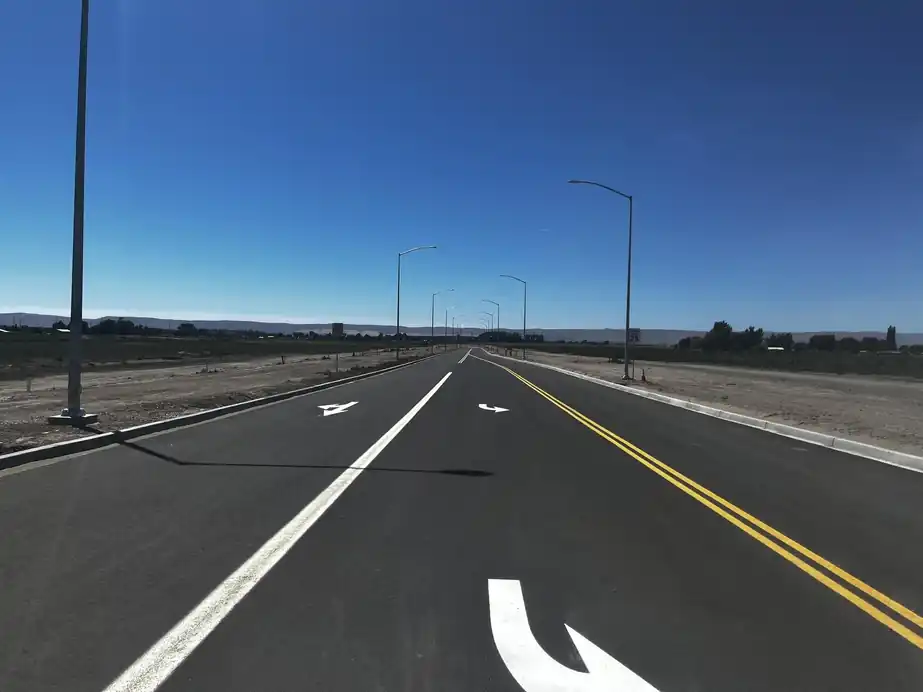
Street light poles are tall and heavy, and they need a proper foundation. We run a digger derrick truck, which is a truck with a boom and an auger that can drill holes and set poles. In the photo with this article you can see freshly installed lighting along new lanes. Setting those poles is crane-style work that needs room, level ground and a clear plan for traffic control, which usually comes from the prime contractor.
Roadway projects we've been part of
Our site lists a good range of public work across Central Washington. That includes electrical work on the Second Street Roundabout for the City of Cle Elum, the Keys Road widening project, the Canyon Road overlay for the City of Ellensburg, the Toppenish Avenue and First Avenue improvements for the City of Toppenish, and the WSDOT Eschbach Road and Ackley Road project. We also handled street light and lift station work at Midvale. Each of these has its own wrinkles, but the pattern repeats: early coordination, conduit before paving, then poles, wire, signals and testing.
Public bids and prevailing wage
Public work comes with paperwork that private jobs don't have. Contractors bidding to a city or county need an estimator who reads the bid documents carefully, a payroll process that handles prevailing wage requirements, and the discipline to document what was installed and when. We offer public bid and government project support for contractors and agencies, from planning through completion, with the documentation, prevailing-wage compliance and coordination public work requires.
If you're a prime contractor putting together a bid, the useful thing an electrical sub can give you is a clear, complete number and a straight answer about what's included. If you're an agency, it's a crew that understands how to work inside your standards and submittal process.
Maintenance after the project ends
The work doesn't end at ribbon cutting. Street lights get hit by vehicles, which is where knockdown repairs come in. Older fixtures get converted to LED. Signals need scheduled maintenance so intersections keep moving safely. Cities and districts that have a reliable local crew on call spend less time waiting when something goes dark on a busy road.
We're based in Yakima and work with cities, counties and utility districts across Central Washington. If you have a public project heading to bid or a lighting problem that needs a crew, call (509) 571-1082 and we'll talk it through.
509 Electric, (509) 571-1082
Call (509) 571-1082More articles
What a UL508A Control Panel Is, and Why a Packhouse Should Ask for One
The label on a control panel says more about your plant's safety and uptime than most managers realize.
Planning Electrical Service for a Cold Storage Room or Packhouse Expansion
Most expansion headaches trace back to a service that was sized for the plant you had, not the one you're building.