Planning Electrical Service for a Cold Storage Room or Packhouse Expansion
Most expansion headaches trace back to a service that was sized for the plant you had, not the one you're building.
October 7, 2026 · 4 min read
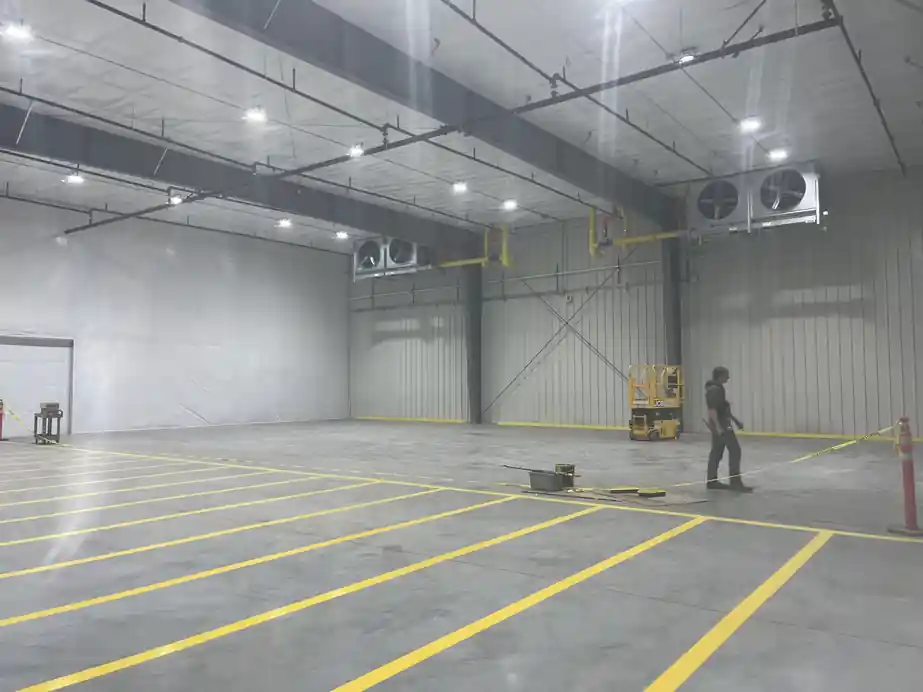
When a fruit packer or cold storage operator adds rooms, the refrigeration equipment and the building usually get the attention. The electrical service feeding it all gets looked at last, often after the schedule is already set. That's backwards. The service is the one piece you can't improvise around once the rooms are built and the season is bearing down.
Start with the service, not the room
Every cold room adds load you can count on. Evaporator fans, defrost heaters, lighting, door heaters, controls and the compressors that serve the room all draw power, and they tend to come on together at the worst moments. Add the packing line equipment that runs alongside, and the total can look very different from what the plant drew five years ago.
The place to begin is a load list. What are you adding, what does each piece draw, and what will run at the same time on the hottest afternoon of the season? Then compare that against the service you actually have: the utility transformer, the service conductors, the main switchgear and the distribution downstream. If any piece of that chain is already close to its limit, the expansion has to start there.
Utility coordination deserves its own mention. A larger service often needs the utility to supply a bigger transformer or change their equipment, and their schedule is not yours. Ask early what they need from you, because that conversation can quietly set the date for the whole project.
Sizing for what you'll add later
Royal Ridge Fruit and Cold Storage had us upgrade one of their services to 3000 amps. The reason was twofold: to make better use of their current equipment for cherry season, and to prepare for future ammonia compressors. That second reason is the one worth copying. They weren't only fixing today's problem. They sized the service for the machinery they knew was coming.
Ammonia refrigeration is common in large cold storage, and the compressors in those systems are big motors. Large motors pull a heavy surge when they start, and they need properly sized feeders, protection and starting equipment, whether that's a drive or a soft starter. Putting that capacity into the service while you're already working on it costs far less than reopening the service gear a few years later. We'd rather see a plant pay a bit more once than shut down in the middle of a season to do it again.
Equipment hookups are part of the plan
A packhouse expansion is rarely only a building. At Double Diamond Fruit in Quincy, our work included the electrical side of a new building extension: relocating existing electrical setups and installing new systems for two additional cold storage rooms. It also covered the circuits and hookups for a new apple bagging sizer supplied by United Sales of Yakima, along with the Haley baggers and Hytrol conveyor lines tied into it. We didn't install the sizer itself. Our job was making sure it was fully operational and connected to the infrastructure already in the plant.
That split of responsibility is common, and it's worth settling on paper. Equipment vendors usually deliver the machine and a list of what it needs. Someone has to turn that list into conduit, circuits, disconnects and controls, and someone has to coordinate it with the other trades. When nobody owns that, you get a sizer sitting on the floor waiting for power.
Sequencing the work around your season
Packers and cold storage operators run on the harvest calendar, and the electrical schedule has to respect it. A few things help:
- Build a shutdown plan early, and identify which feeders and panels can be switched over without stopping the whole plant.
- Order long-lead gear such as switchgear, drives and transformers as soon as the scope is firm, since delivery times change and aren't something we can promise.
- Pre-build control panels in the shop, so the on-site work is mostly setting, landing wires and testing.
- Agree on who is responsible for labeling, drawings and startup testing before the first conduit goes in.
Pre-building is a real advantage when your downtime window is short. Our Yakima shop builds custom control panels to the UL508A standard, so panels can be built and documented before the crew ever opens a wall. Field time shrinks to installation and checkout.
Where this leaves you
A well-planned expansion starts with a load list, a conversation with the utility, a realistic view of what you'll add next, and a clear owner for every piece of equipment that needs power. The expansion itself then goes the way you expect, instead of becoming a series of discoveries made after the walls are up.
If you're thinking about new rooms, a bigger service or a line upgrade, we're glad to walk the plant with you. We work across Yakima and Central Washington, and you can reach us at (509) 571-1082. Bring whatever drawings and equipment lists you have, and we'll tell you plainly what we see.
509 Electric, (509) 571-1082
Call (509) 571-1082More articles
What a UL508A Control Panel Is, and Why a Packhouse Should Ask for One
The label on a control panel says more about your plant's safety and uptime than most managers realize.
How Street Lighting and Traffic Signal Work Fits Into a Public Road Project
Lighting and signals look like the last thing installed on a road job, but the electrical work starts well before the paving.